
Ask the Developer Vol. 24, The Legend of Zelda: Ocarina of Time – Chapter 3
4 November 2026

4 November 2026


Shop online
Earn My Nintendo points
Save a wishlist
Some of the images and videos shown in text were created during development.
This article has been translated from the original Japanese content.
Chapter 2: The visuals may change, but the experience does not
Chapter 3: Adapting the game for a modern era
Ng:
Even with Link’s actions, we agreed that the fundamentals of the original game should be preserved.
Taguchi:
There are many different ways to approach a remake. One common method is to port the original game’s code and data, then build on that foundation with updates and refinements to give the game a more modern feel. However, because 28 years had passed since the release of the original game, we needed to recreate everything from scratch this time. So, we’d implement a feature, compare it with the original game, and then repeat that process over and over. We were mindful of rebuilding the game in a way that wouldn’t turn it into something completely different. That hard-to-describe sense of responsiveness you get from actions and the like was something we paid especially close attention to in research and development. In addition, we’ve made adjustments so that people who've played titles from The Legend of Zelda: Breath of the Wild onwards won't find the experience jarring as they make their way through the adventure.
Ng:
Speaking of jarring, that’s also one of the reasons we removed auto-jump. In the original game, there wasn’t a button assigned to jumping. It was designed so that Link would automatically jump when players pushed the Control Stick forward in specific locations, so the places where jumping was possible and where it wasn’t were clearly defined. However, players who are used to more recent games may wonder, “Why is it that Link could jump over there, but not here?” So, for Link's jump, we carried over the controls from more recent titles in the series and made it possible to jump anywhere with a single button press.
Aonuma:
That makes exploration much more exciting, but since there were places where we preferred players not to jump, the auto-jump system was, in some ways, convenient from a development standpoint. If you remove that restriction and make it possible to jump anywhere, you need to anticipate all kinds of player behaviour and make corresponding adjustments to the environment. So at first, we were like, “Are we sure about this?” (Laughs) So, even a single change can instantly increase the number of things that need to be reviewed.
Shida:
In addition to that, The Legend of Zelda: Ocarina of Time features both Adult Link and Young Link, and in fact, the distance they can jump differs slightly between the two. Even when designing a single piece of terrain, it was challenging to find the right balance in terms of making gaps just the right distance to jump across.
Taguchi:
Related to the jump, there’s also an action called Jump Attack. In the original game, it could be performed with a single button press, but for this game, we’ve adopted the two-step approach used in The Legend of Zelda: Breath of the Wild, where players press the jump button first, then press the attack button during the jump.
Aonuma:
Trouble was, I was so used to the original game’s controls that I just couldn’t get the hang of it. (Laughs) When I told the team, “This just doesn’t feel as satisfying as the original Jump Attack”, they added a way to perform it with a single button press.
Fujibayashi:
I, on the other hand, was more used to jumping first and then attacking. In the end, we implemented both control schemes so that fans of the original game, as well as those who've played The Legend of Zelda: Breath of the Wild but not The Legend of Zelda: Ocarina of Time, could have a comfortable experience. That said, neither control scheme gets in the way of the other.
Ng:
The same applies to dashing. We wanted to preserve the experience of spamming the Roll Attack to forward roll your way across Hyrule Field. (Laughs) So while keeping that option, we also made it possible to dash by holding down the Roll Attack button. I think we were able to bring all of these adjustments together with confidence because everyone on the team had experience developing past The Legend of Zelda games.
Fujibayashi:
There's a big difference between the controllers. These days, having two control sticks and being able to control the camera freely have become the norm, and that’s one clear difference from the original game. Precisely because of that, I think one of the biggest challenges was figuring out how to modernise the controls while preserving the strengths of the original game.
Taguchi:
Taking into account the feel of the original game's controls, we worked closely within the team to ensure that players familiar with more recent The Legend of Zelda titles could adapt to the controls smoothly and naturally. Additionally, we’ve made adjustments in the hope that players will notice the subtle differences. For example, when revisiting a location as Adult Link that they had previously explored as Young Link, they might think, “Huh, this place feels smaller than it did before”.
Aonuma:
In the original game, the camera was fixed at certain points, but when you can freely rotate the camera and look at the surroundings, you're more likely to spot things that interest you and think, “What’s that? Maybe I’ll go check it out”. The world has been rebuilt with a high level of density, and now that you can view it from all sorts of angles, I’m sure there will be countless things that catch your attention.
Taguchi:
But because players can freely rotate the camera, we were concerned that they might lose their sense of direction and end up getting lost. For example, when you’re trapped in a room inside a dungeon and the door opens after you defeat the enemy, you can lose sight of the direction you wanted to go and find yourself thinking, “Which way was it again?”
Ng:
That’s why, in this version, we made various adjustments to make it easier to understand where the player is headed. With the camera being freely controllable, there are more things that players need to work out for themselves.
Aonuma:
We all knew that expanding players' freedom would lead to more challenges in development. But I think we chose to take on those challenges anyway, tackling them one by one as we worked out how to adapt the game for a modern era.
Fujibayashi:
Aonuma-san and I looked at what the team had developed from the perspective of first-time players and pointed out anything that seemed difficult to understand. We went through that process repeatedly.
Ng:
We basically retained the dungeon mechanisms from the original game, but we did make some adjustments to improve playability. For example, we placed objects in such a way that players intuitively figure out which direction to go. So if you look closely, you may notice areas where the layout differs slightly from the original game.
Aonuma:
I had some overdue homework: I wanted to do something about the Water Temple I created 28 years ago. (Laughs) Since it became well known for its difficulty in the original game, I had the team make some adjustments in this version. When I designed the Water Temple all those years ago, I wanted to create an experience where simply being underwater was fun. It was a time when there were very few 3D games that even let players go underwater. I enjoy freediving, and what I find fascinating about being underwater is how different everything feels. The sounds change, and it feels like you’re in a completely different space. I wanted to create a place where players could experience those sensations. However, with the dungeon’s complex structure and a lot of item toggling involved, you often had to open the menu screen repeatedly, making it hard to keep track of where you were and which way you were facing. We addressed those issues in this version.
Ng:
In this version, we’ve made item toggling much easier. We also changed some of the walls that made it easy to lose your sense of direction to lattice-style structures, making it possible to see the rooms beyond them and get a better sense of the overall space.
Taguchi:
For the bosses, we also struggled quite a lot in the early stages of development to decide where to draw the line in terms of what to change and what not to. For example, Gohma, the first boss players encounter, can only take damage if you hit its weak point at the correct timing. However, in the original game, it was a little difficult to tell exactly when you were supposed to attack. As we struggled with what to do, one of the team members figured we could make it clearer by taking advantage of the two arms on top of Gohma’s head. So we made it so that Gohma guards its weak point with those arms anytime it’s immune to attack. When that worked and made things easier to understand, I felt a real sense of confidence for the first time. I thought to myself, “So this is how you make it feel new again without changing its essence”.
Ng:
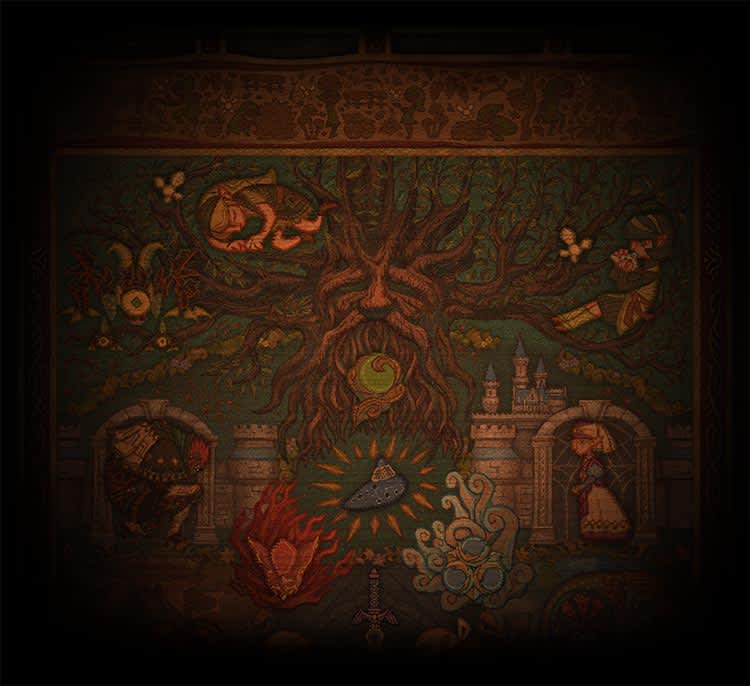
I imagine that some of the people who played the original game as kids now have children of their own. When they play this new version of The Legend of Zelda: Ocarina of Time together, we thought it would be nice if it gave them a shared topic of conversation, something that might lead to moments like, “This is what happened in the story”. That idea is what led to the creation of the Threads of Time. It combines a feature that supports the adventure with one that lets you follow the story like a picture book. As the story unfolds, new illustrations and passages of text are unlocked, eventually coming together to form a single tapestry.
Shida:
Once the direction was set and we decided to create the illustrations for the tapestry, we were confident that it was going to turn into something special.
Fujibayashi:
The story itself was already complete back then, but presenting it in this way is a whole new approach introduced in this version.
Ng:
Even within the development team, it served as a kind of reference for gaining a deeper understanding of the world, leading to realisations like, “Oh, so this is how what happened here connects to that”. More than anything, I personally would be happy if it became a conversation starter that encourages players of different generations to share memories with each other. “You know, your Dad got stuck in the Water Temple plenty of times back in the day.” (Laughs)
Aonuma:
Then kids playing this version might say, “Come on, it’s not that hard”. Poor old Dad might end up feeling deflated.
Everyone:
(Laughs)