The making of the music of Kirby Air Riders – Chapter 3
23 March 2026
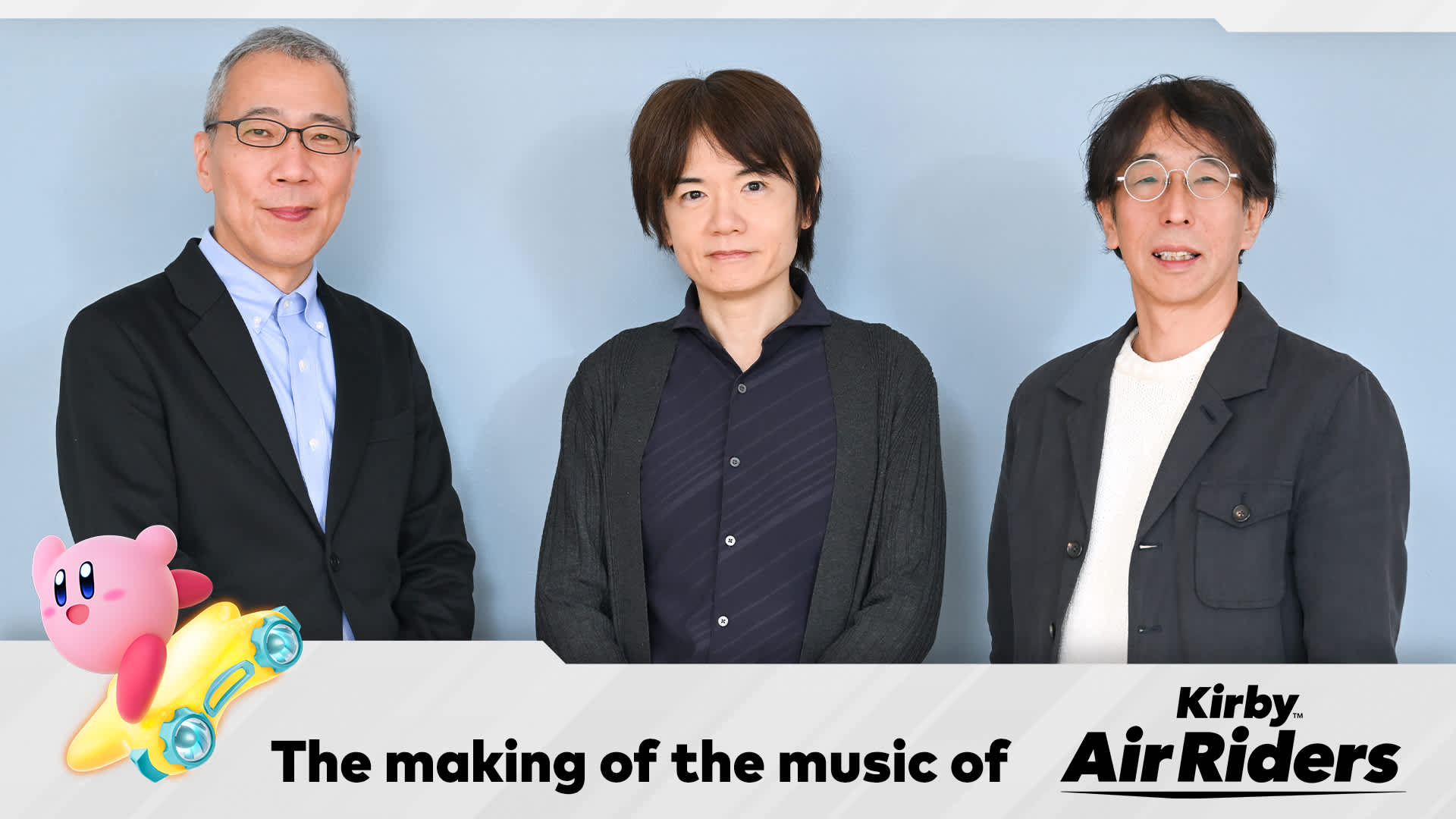
In chapters 3 and 4, we delve into the secrets behind the creation of the main theme, Starlit Journey (JP ver.), take an inside look at the recording process, and hone in on the meticulous process of fine-tuning the music.
Chapter 3: Revealing the lyricist for the main theme...
Sakurai:
The main theme was okayed on the first take, wasn't it?
Iwadare:
I presented you with three songs out of nowhere. I started making what I thought was "the one" but then felt like something was off. That was my first take. I realised I needed to make something cheerful that children could sing along to, so I had a super cheery song as my second take. But then I reconsidered it yet again, thinking that I'd overdone the cheeriness a little. So I made a third take.
Personally, I felt like the third one was the best, but I wanted Sakurai-san to make the decision and submitted all three.
Sakurai:
The second one you mentioned just now became Starlit Journey (JP ver.), and the third one became the ending theme, Starlit Journey: Free (JP ver.).
Iwadare:
The lyrics are the same in all three songs, since we made them lyrics-first (10).
(10) A song-writing technique where the lyrics are created before the melody.
So you intended for one song to be chosen from the three you submitted, but two were chosen?
Iwadare:
Yes, that's right. I was really surprised. (Laughs) Later on, they had me make an instrumental version (11), a solo version of the ending song, and all kinds of different arrangements of the main theme. Because two songs were selected, my workload effectively doubled. I got to try all sorts of things though, so it was a lot of fun.
(11) An instrumental version is a song without the vocals.
Sakurai:
Your first take was a great song too. It just goes to show how much better the other two were. By the way, regarding the lyrics for the theme song, I haven't mentioned it yet since I wanted to keep it under wraps, but I wrote them myself.
Animation directors, for instance, sometimes use a different name when releasing music, right? As a child, I really couldn't understand why they would do that. Now I understand that you shouldn't have that work's world associated with a single person. Of course, there might be completely different reasons for it too.
It would bother me a great deal if people thought that the world of Kirby Air Riders was a certain way because I'm the one who made it. I want to keep fantasy as fantasy, to have a certain theme song because this or that happened in the Kirby world. I'm only bringing this up because we are discussing the circumstances behind the main theme this time around...
I had been thinking of the main theme as basically one song, but the lyrics I wrote had two sides to them. On the surface, the song expresses the joy of being together with the machines, but underneath all that is Zorah's wish to regain his lost freedom as well. Iwadare sent me three great songs, and it occurred to me that we could use the third song, his third take, and integrate it into a Zorah-themed ballad of sorts.
But I was a little lost on how to actually make it work. The track that was sent to me was really just the first step. From there, it was going to be a very long road until it became a complete song. Even so, I decided to go ahead with it because I'd personally never heard a song where the lyrics conveyed two completely different sets of emotions through layers of connotations. This felt novel to me, so I asked Iwadare to take on the challenge.
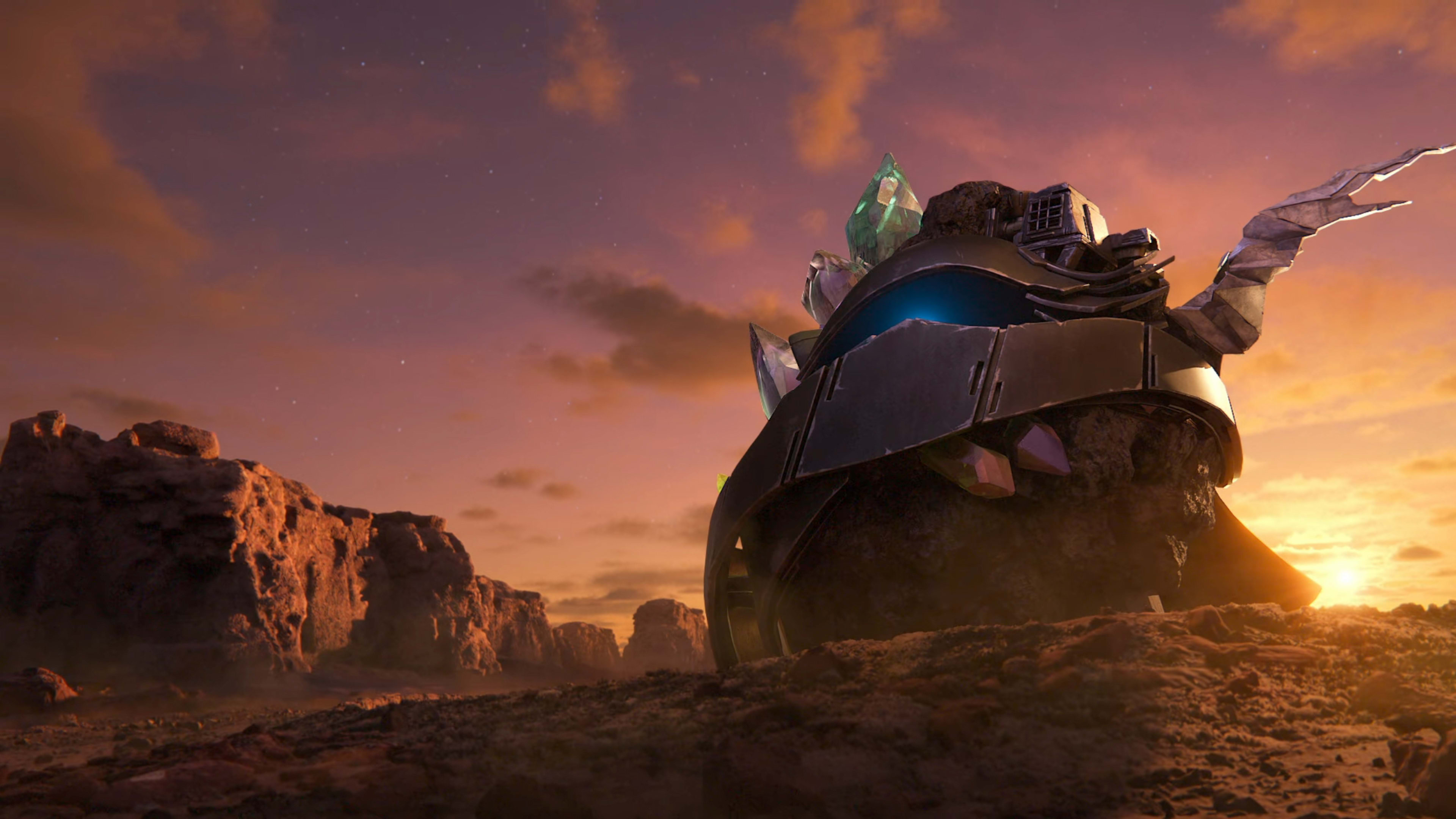
When it comes to the lyrics, my basic premise is to remove anything that isn't necessary and keep the phrases simple and short. I also pay a lot of attention to how the words sound, and have the A-section and chorus all follow a 7/5/7/5/7/7 pattern.
Horizon vast, unending, swirling clouds above.
Long and winding roads call out, beckoning you on.
Now with everything you need, it's time to depart.
Fire up your machine and feel the engine roar!
Soaring high, like shooting stars in the sky,
whistling by in a symphony of speed.
Racing on, faster than all our fears, we'll break through,
knowing we've finally reached our long-awaited dreams!
See glittering oceans, flora lush and green,
creating a work of art as you hit full speed.
In the glow of evening light, our song hums along,
a tail wind at our back propelling us on!
Now fly, like shooting stars in the sky,
higher than anyone who came before!
Don't look back, 'cause nothing can hold you down.
You are horizon bound, meant to be weightless and free
in the infinite skies!
An arc of red streaks through the stillness of dark.
It flashes, then fades away, far into the stars.
Yet in warm rays of dawn, we will journey on
through the unknown, into the fray,
machines lighting our way!
Soaring high, like shooting stars in the sky,
whistling by in a symphony of speed.
Racing on, faster than all our fears, we'll break through,
knowing we've finally reached our long-awaited dreams!
Now fly, like shooting stars in the sky,
higher than anyone who came before!
Don't look back, 'cause nothing can hold you down.
You are horizon bound, meant to be weightless and free
in the infinite skies!
How is it in reality? As musicians, have either of you worked on a song that had a single set of lyrics but two distinct themes before?
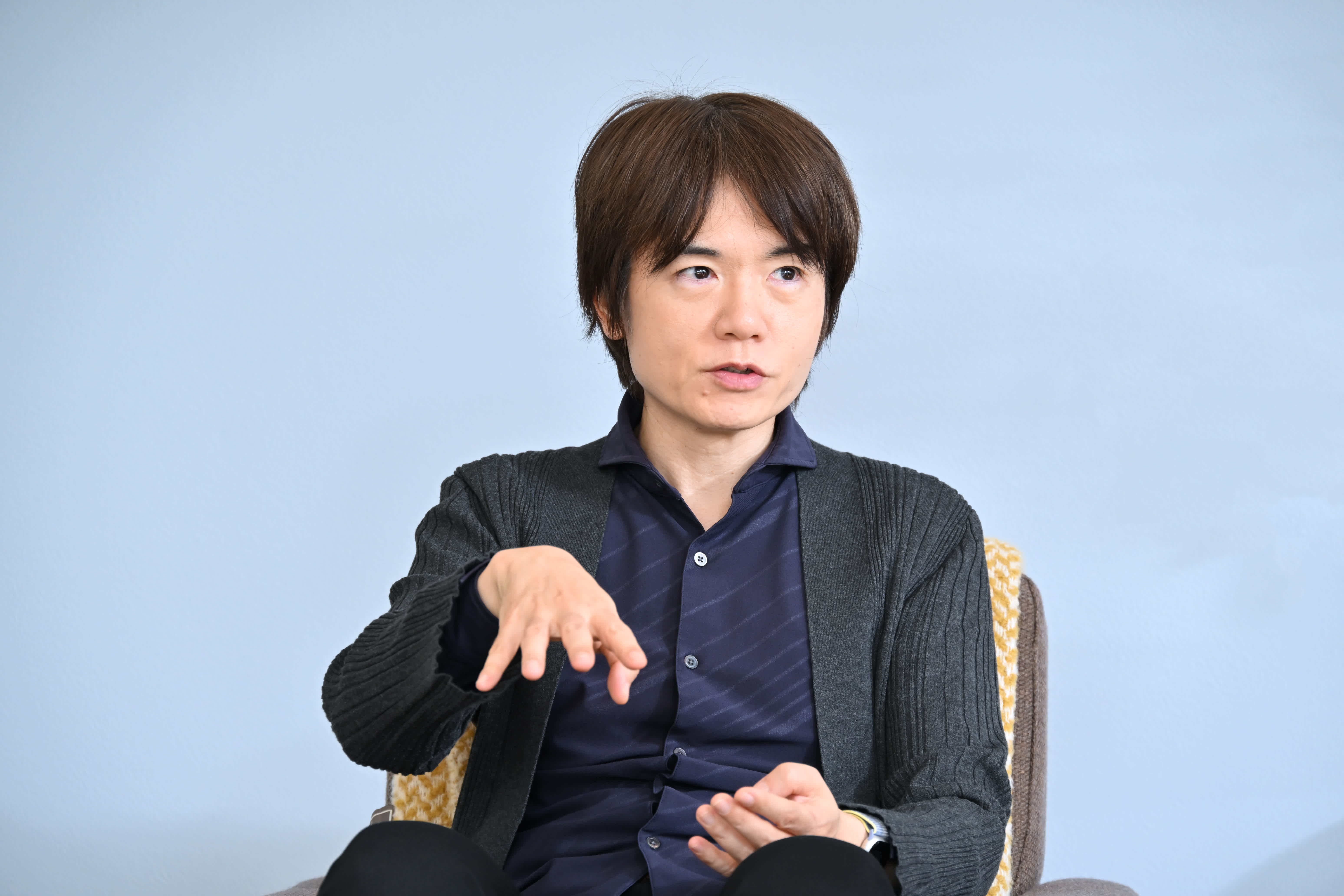
Sakai:
No, I've never heard of that before. Needless to say, I've never made anything like that either.
Iwadare:
Nothing comes to mind. Once I've fully developed a song, only that particular melody comes to mind for those lyrics. Thankfully we were still just in the beginning stages this time, so I still had plenty of melodies to give.
Sakai:
Iwadare-san, after you finished those three songs, you did say you could make 10 more if you were asked to. (Laughs)
Iwadare:
I was really in the zone at that point. (Laughs) Like I could switch modes and move on to a different song after one day. So I figured I could work while exploring different aspects. I think it actually might have been because the lyrics had so few words.
Sakai:
Good point. The simple lyrics and tone were a good thing, they made it easier to come up with melodies.
Iwadare:
I must have been really into the different aspects part of it.
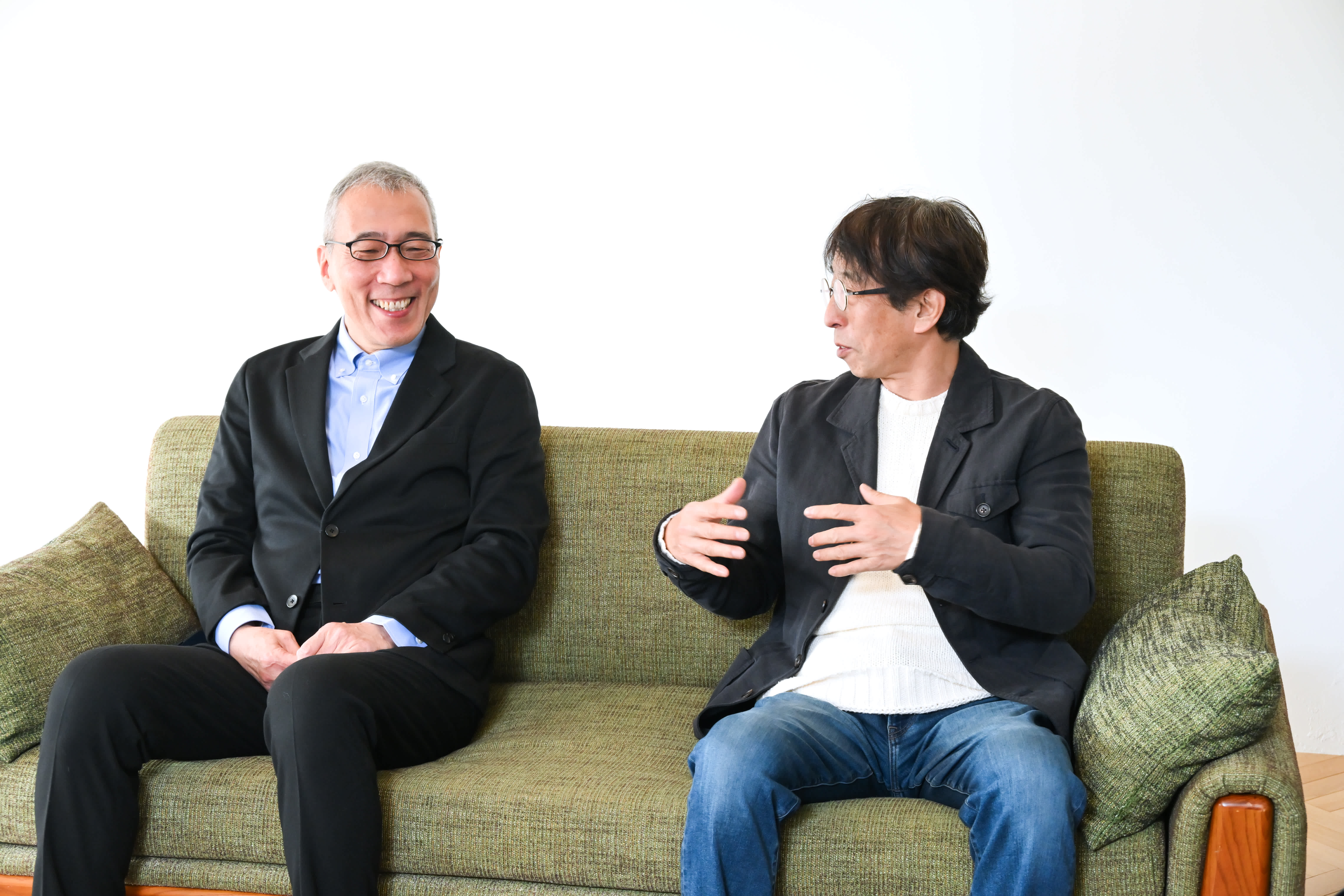
Sakurai:
It's really the rhythm that makes the words sound good, isn't it.
Iwadare:
Yet in the Japanese chorus, one of the lines started with three syllables and another started with two.
Sakurai:
I thought that would make things difficult too, and tried hard to find alternatives, but no matter what similar word I changed it to, it would just feel completely different. So I stuck with it.
Iwadare:
You really had me scratching my head while working on it. (Laughs)
Sakurai:
There's another similar spot too, for a certain Japanese word that could be read as three or four syllables. I wrote it with four syllables in mind, but when the song was first finished, I realised it had been composed to three syllables instead. Still, it fit the rhythm of the song, and that was good enough for me.
Iwadare:
Yeah, I didn't think it could be read as four syllables. It didn't fit lyrically, and three sounded better to me, so that's what I went with.
Sakurai:
The best songs are the simple ones, after all.
Iwadare:
I was very conscious of sticking to making a song that a child could sing. While I was working on my second take, I wanted to create buzz with band music, so I just used band instruments for the chords, and that's how the current accompaniment came to be.
Sakurai:
At first, when making the main theme for City Trial, we discussed whether we should go with galop (12) for the tune. In the end, it did turn out somewhat similar to that.
(12) A musical term for a lively, galloping rhythm in a duple meter.
Sakurai:
Now, back to the discussion about the way words sound. The course 'Steamgust Forge' is named 'Machine Gust' in Japanese, and it has a longer vowel sound, so it's pronounced "Machiiine Gust". But the Air Ride "machines" that appear in this game use a shorter spelling of this word, so you'd think it'd make sense to use the shorter spelling of "machine" in the course title as well, right?
Sakai:
Yes, I was wondering what was up with that inconsistency.
Sakurai:
The one with more characters is better. Not because it just had to have more characters. It's hard to explain why it sounds better, but I wrote it that way because I think it's important. For the lyrics for Starlit Journey (JP ver.) as well, they were much shorter at first, but I supplemented them for the sake of the song.
Iwadare:
The lyrics were way too short, it was a real problem for me. (Laughs)
Sakurai:
There was one line in the Japanese song in particular that was made longer afterwards. Aside from that we mostly kept it the same, and I think we did a pretty good job of bringing it all together.
Another thing I thought about while creating the lyrics was to have the imagery in mind. For example, in the Japanese lyrics there's the line, "Load up your luggage, light a fire", but Air Ride machines can't actually carry any luggage. (Laughs) So it feels a little inconsistent when thinking about it in-game, but "load up your luggage" does convey the feeling that something is about to begin, don't you think? Like a journey is about to start, or you're heading out somewhere. By using figurative expressions like these, I aim to evoke emotion and imagery in each line.
Sakai:
The line about reaching long-awaited dreams makes the listener feel like the song is about them, and then they'll have the secondary impression of it maybe being about Zorah. It's the kind of thing that gives you goosebumps later on.
Sakurai:
And also, for the ballad version (Starlit Journey: Ballad (JP ver.)), we actually considered using Vocaloid software to bring out Zorah's mechanical aspect, didn't we? We put a slight effect on the voice, but it was hard to get it sounding like something semi-alive or incomplete. We went back and forth numerous times between the effect sounding too robotic or too human.
Iwadare:
The one thing I clearly remember about the main theme was the English lyrics. Sakurai-san turned down every suggestion to have the lyrics sound better translated a certain way, and insisted on keeping them exactly as they are. Even for the English lyrics, he was extremely particular about keeping the word count tight, and making sure that the phrasing didn't sound strange or unnatural.
Sakurai:
I think you might have misunderstood something there... There are certainly parts that differ from the Japanese lyrics. That said, I do remember when they translated a section as "shooting stars in the night", and I told them it'd be a problem for it to be nighttime in that spot. The overall lyrics take place over the span of a day, so we can't have the time of day suddenly changing.
This isn't directly related to our current discussion, but during the translation period, there were times where we asked for adjustments to avoid contradictions in the game's setting. Because otherwise, what each person pictures in their mind would end up inconsistent.
Sakai:
That's truly a director's perspective to have.
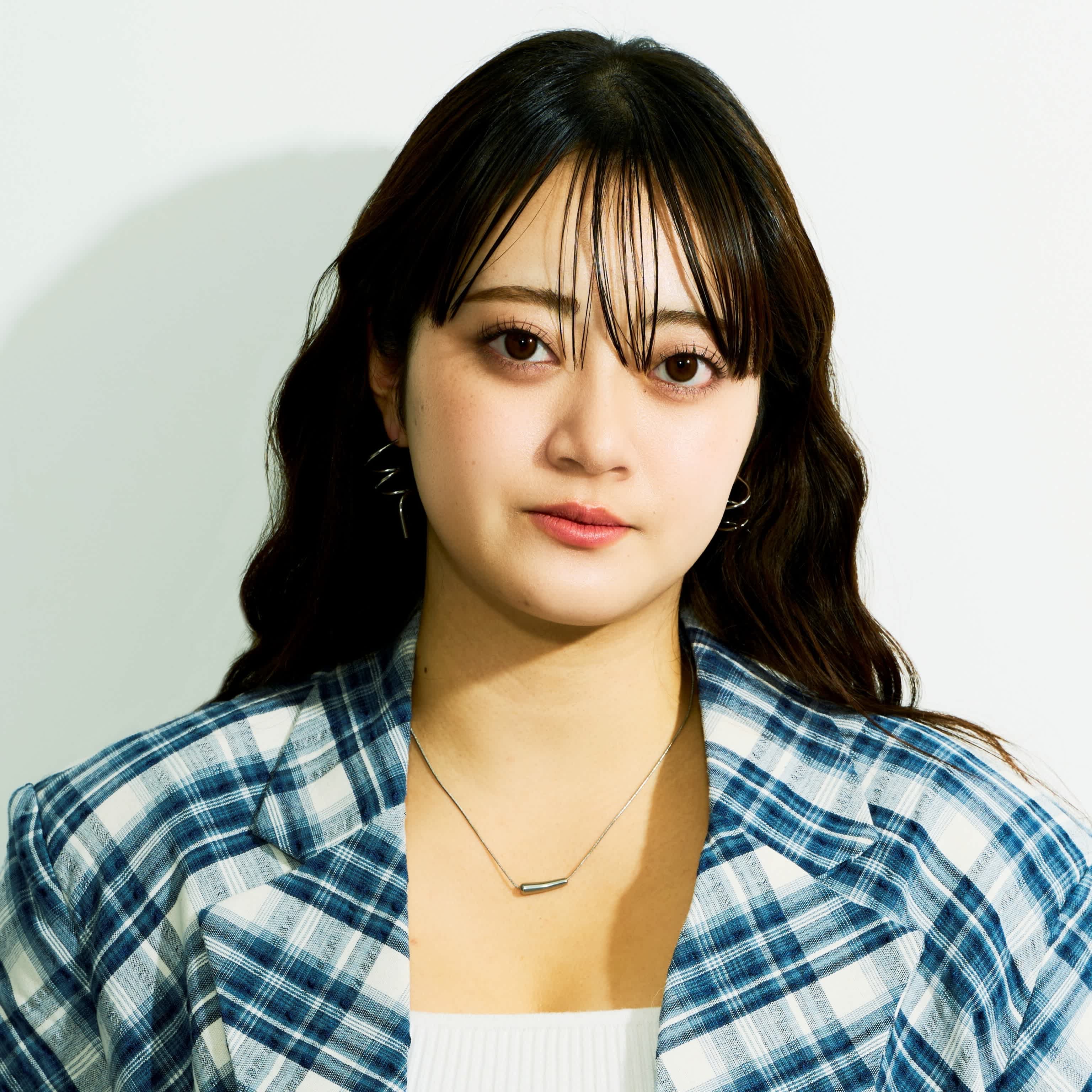
How did you decide on the vocalists for the main theme, YuReeNa and Sayo?
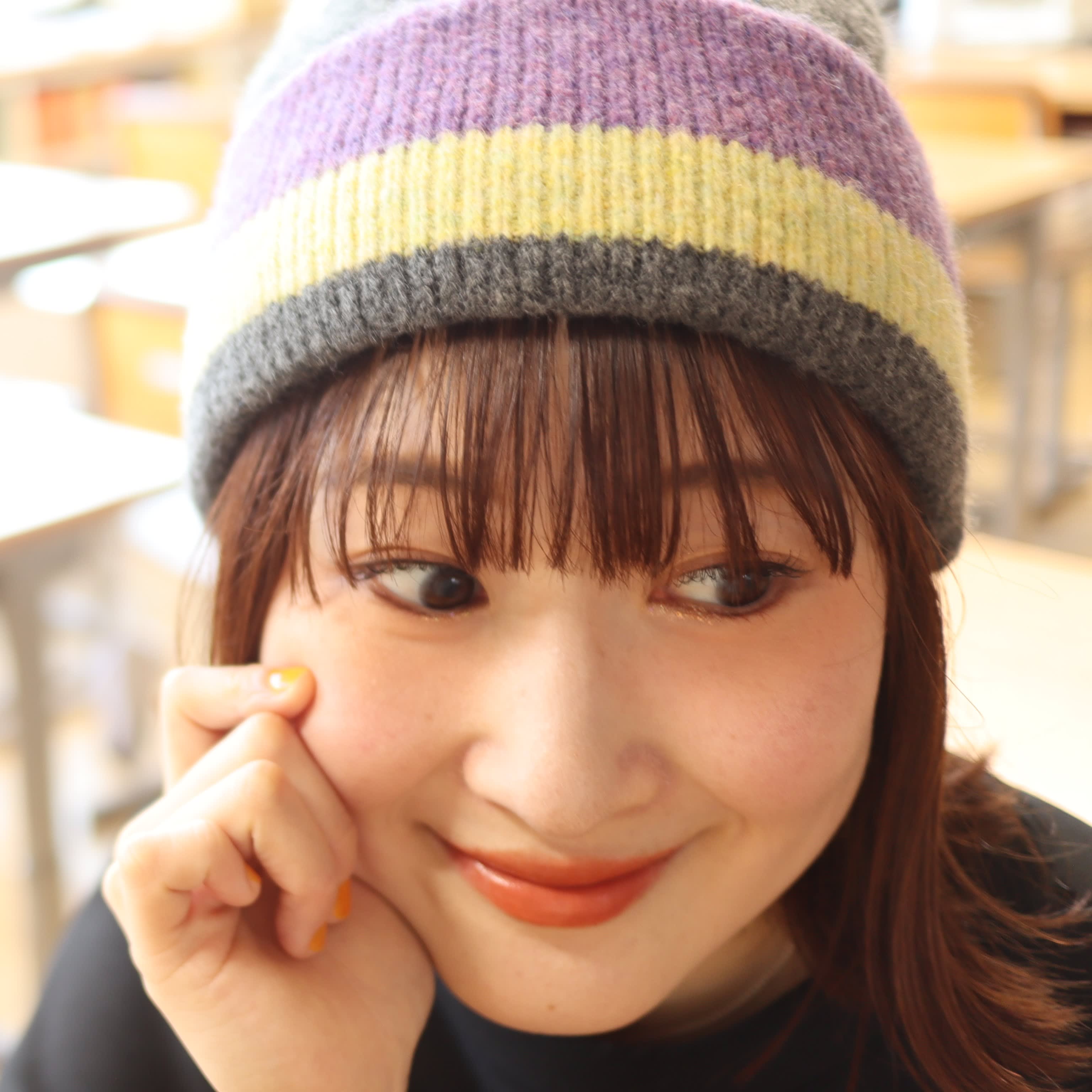
YuReeNa (pictured left): vocalist for the main theme, Starlit Journey (JP ver.)
Sayo (pictured right): vocalist for the ending theme, Starlit Journey: Ballad (JP ver.), Starlit Journey: Free (JP ver.)
Sakai:
We made a request to Face Music (13), and they sent us several candidates.
(13) Handled the coordination of performers and studios for this title.
Iwadare:
We had already decided which key the song would be in, so we searched for people who would suit it, listened to them together, then discussed it and made a decision.
Sakurai:
All of the candidates were excellent, but since we didn't want anything too distinctive for the song itself, we chose those with a more neutral singing style.
Iwadare:
It was difficult to convey how we wanted them to hold back and adjust their singing style.
I actually thought it would be best to convey this intention to YuReeNa-san directly before recording, so I had her practice at a local karaoke store while explaining it to her. Thanks to that the recording went comparatively smoothly and we were able to get a good take.
On the other hand, Sayo-san seemed to struggle with the low key. After multiple takes, we were able to get a good recording with vocal scoops and vibrato kept in check. The song that Sayo-san sang was actually originally intended for a male vocalist.
Incidentally, both of them happened to be very big Kirby fans, so they were really nervous speaking with Sakurai-san online for the first time. (Laughs)
Sakurai:
From what I saw of them online, they didn't seem like that at all though?
Iwadare:
No, not at all. During our meeting, I had only told them that myself and staffers from Bandai Namco Studios would be present, and, without mentioning your name directly, I mentioned that another director might be there. Then you came in and said, "Hello, Sakurai-san here". And the two of them said, "We can't believe Kirby is actually here!".
Sakurai:
I'm not Kirby, though. (Laughs)
Iwadare:
We'd heard these singers' very first songs, and during recording we sometimes felt bad that we were forcing them to sing with so little emotion, despite being such good singers.
Sakurai:
There were points where we had them hold back from using their signature styles.
Iwadare:
Yes, even though we asked them to sing in a way that toned down their strengths, we were able to get some good takes out of them.
Sakurai:
After all, it's the final product that matters the most. I'm very glad that the final product has been well received.
Sakai:
During production, Sakurai-san actually blurted out, "This might be my favourite ending out of all of the games I've made so far". I got a little choked up when I heard that. You're usually so unfazed by everything, but even you felt that way!
Sakurai:
Hey now, don't make me sound like some kind of emotionless monster. (Laughs) That ending is great because, in terms of pacing, the tension builds and then releases very cleanly. The rebound is huge. I want people to really feel that.
Sakai:
That's why when I heard you say those words, I really was overjoyed. Though I haven't actually seen the ending in the game yet myself. (Laughs)
Iwadare:
Me neither.
Sakurai:
The pair of you need to go rescue Zorah. (Laughs)
Continue to chapter 4: An extravagant recording
Over 100 tracks from Kirby Air Riders are now available to listen to in the Nintendo Music smartphone app, available exclusively for Nintendo Switch Online members.
Apple and the Apple logo are trademarks of Apple Inc., registered in the U.S. and other countries. App Store is a service mark of Apple Inc.
Android, Google Play, and the Google Play logo are trademarks of Google Inc.