Kirby Air Riders: Development Insights with Masahiro Sakurai – Part 1
17 April 2026
![[KAR Dev Insights Part 1] Hero](https://assets.nintendo.eu/image/upload/f_auto/q_auto/v1776296003/NAL/Articles/2026/04-april/kirby-air-riders-dev-insights-pt1/kar_development_insights_hero.jpg)
Join Kirby Air Riders director Masahiro Sakurai as he shares insights into the development and details behind some of the game's modes and features.
Contents:
How Air Ride courses are made
Masahiro Sakurai:
At first, we had around 20 motifs as text headings listed in our design document. Galactic Nova was around back then, too.
After that, the team reviewed it internally and selected the ones that highlight the differences and variations of each course as much as possible, then worked on expanding and refining the content of those motifs. For example, Waveflow Waters was based on the concept of "living water".
Once we've made some progress, we split into two groups and continue development: one for course layout and one for artwork. Essentially, design and visuals.
This applies in both cases. As an example, for the steampunk world of Steamgust Forge, we first outline the concept, identifying what elements are essential for steampunk. From there, we envision potential types of gameplay, and then reinforce the design.
Once the concept is ready, we refine it on paper, develop the ideas further, then create prototype models. All kinds of issues come up when running the prototypes, so we keep reiterating by testing and tweaking them again and again.
Creating models based on the concept art happens further down the line, but for the sake of efficiency, we proceed area by area first. A lot of work happens after that as well, but this is generally how it starts out.
![[KAR Dev Insights Part 1] Map 1](https://assets.nintendo.eu/image/upload/f_auto/q_auto/v1776296004/NAL/Articles/2026/04-april/kirby-air-riders-dev-insights-pt1/KirbyAirRiders_DevelopmentInsights_Map_01_EN_image950w.jpg)
*Initial concept for Mount Amberfalls
1. Outline of the first course proposed by the design team, with multiple curves.
![[KAR Dev Insights Part 1] Map 2](https://assets.nintendo.eu/image/upload/f_auto/q_auto/v1776296003/NAL/Articles/2026/04-april/kirby-air-riders-dev-insights-pt1/KirbyAirRiders_DevelopmentInsights_Map_02_EN_image950w.jpg)
2. The areas highlighted in red have been tweaked by Mr Sakurai. Rope bridge/hairpin turns/flight zone/ocean foreground have been added as features.
![[KAR Dev Insights Part 1] Map 3](https://assets.nintendo.eu/image/upload/f_auto/q_auto/v1776296003/NAL/Articles/2026/04-april/kirby-air-riders-dev-insights-pt1/KirbyAirRiders_DevelopmentInsights_Map_03_EN_image950w.jpg)
3. Further adjustments. More hairpin turns. Big jumps. The waterfall area where players descend using a series of super jump ramps.
Quick note: actually, I'm a little bothered by the direction of the sunlight on the coastline. Currently, the sun is positioned to the left of the summit… Given the direction of that sunset, the coastline must be facing toward the north. Somehow, I feel like it would be more natural if it was facing south... Well, this is Planet Popstar, so it's probably fine.
Air Ride courses are like amusement park rides
Air Ride courses are designed with amusement park rides in mind. This is the same thinking we've had since the previous game. We want to create an immersive game that can be thoroughly enjoyed like a tour, with themed worlds and fast-moving sights that keep changing as you progress.
Additionally, each course has its own areas and features, and by incorporating certain gameplay elements, we were aiming for an experience that leans more towards that of an action game.
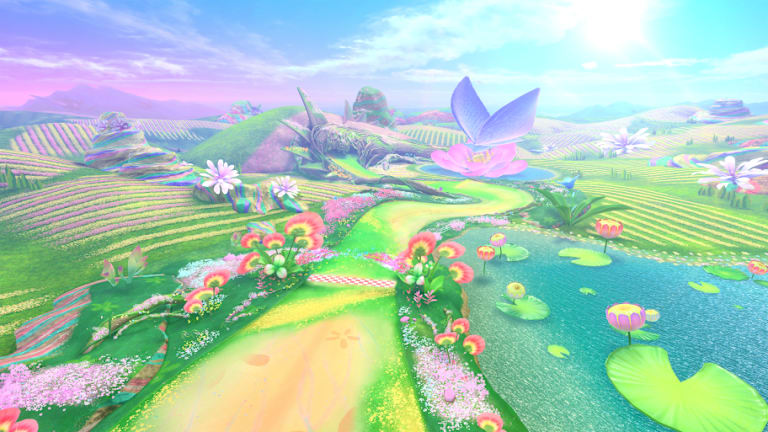
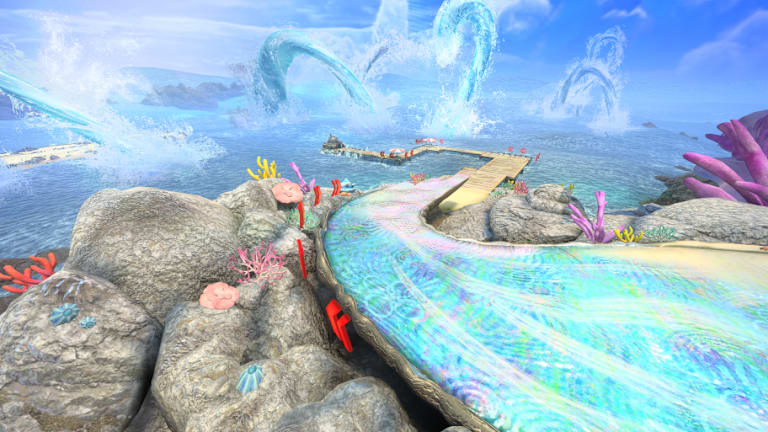
However, in my initial plan, I wanted the courses to be a little shorter than they are now. A little shorter and more condensed.
The thing is, action racing games are all about the comebacks. I think it's a bit of a pity that players tend to jostle for 2nd place on the last bend, since what happens along the way doesn't factor in that much. I wanted to keep the courses shorter and punchier, but the design team got a little carried away and crammed it full. (Laughs)
From Air Ride machines to Top Ride machines
Basically, we create the Air Ride machines first, and then rework the parameters for use in Top Ride. For instance, the flight abilities between Air Ride and Top Ride differ. Top Ride machines barely fly.
This means that, if all other aspects were the same, machines that excel at flying won't perform very well in Top Ride, and the land-based machines would have an advantage. Moreover, Top Ride courses have more twists and turns than Air Ride. There aren't many straight paths, so machines like Formula Star that specialise in moving in a straight line would be at a disadvantage. Either way, achieving balance with identical functionality is impossible.
![[KAR Dev Insights Part 1] Image 3](https://assets.nintendo.eu/image/upload/f_auto/q_auto/v1776296001/NAL/Articles/2026/04-april/kirby-air-riders-dev-insights-pt1/KirbyAirRiders_DevelopmentInsights_Ch1_06_image950w.png)
It's incredibly difficult to balance such starkly contrasting advantages and disadvantages while maintaining the smooth and pleasant feel of Top Ride's controls. I think the team did a great job on this.
During development, the machines designed for Air Ride were accidentally put into Top Ride. We understood first-hand that it wouldn't work. They were too fast, we couldn't make the turns, we flew too far, and so on.
I'm glad that the smooth drifting movements in Top Ride ultimately turned out well. I think we were able to make it pretty fun while retaining the different abilities of the machines.
Cutely depicting a small world
Top Ride is, at its base, an RC toy-like game, so I thought it would be nice if we could add in a little more expressiveness for these tiny and adorable driving machines. But implementing a tilt-shift filter was trickier than I expected.
If we overuse it, visibility drastically decreases and processing load increases. It becomes surprisingly difficult to maintain focus (depth of field). Because scenes are dynamic with a lot of zooming in and out, the appropriate amount of blur to add to the foreground and background will vary depending on the situation.
To compensate for that, we made meticulous adjustments such as lowering the default camera angle significantly when using the tilt-shift effect, among other things.
![[KAR Dev Inights Part 1] Image 4](https://assets.nintendo.eu/image/upload/f_auto/q_auto/v1776296002/NAL/Articles/2026/04-april/kirby-air-riders-dev-insights-pt1/KirbyAirRiders_DevelopmentInsights_Ch1_07_image950w.png)
It might be fine for a photograph, though. When the scene is stationary, you can see clearly where the focus should be.
Devising ways to keep players on track
A common feature across all courses is the placement of obstacle lights near clipping points. A "clipping point" is the spot where a vehicle comes closest to the inner-edge of a corner when performing a technique like the "racing line". These lights are placed as one way to enhance course visibility.
Both Air Ride and Top Ride have bright and colourful graphics, so you can easily lose track of where you are on the course when you're driving around. That said, rendering terrain sharply while blurring the background to create contrast can be surprisingly difficult in 3D games.
Depth can be expressed to some extent using atmospheric perspective, like fog. However, it is extremely difficult to make the edges of a course or corner clearly discernible, and this was something that I frequently pointed out during the review process.
So, we made it a rule to use obstacle lights instead of relying on graphical adjustments alone.
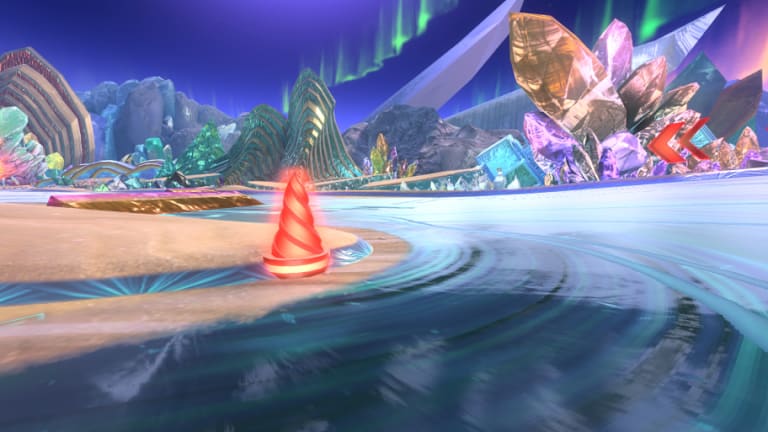
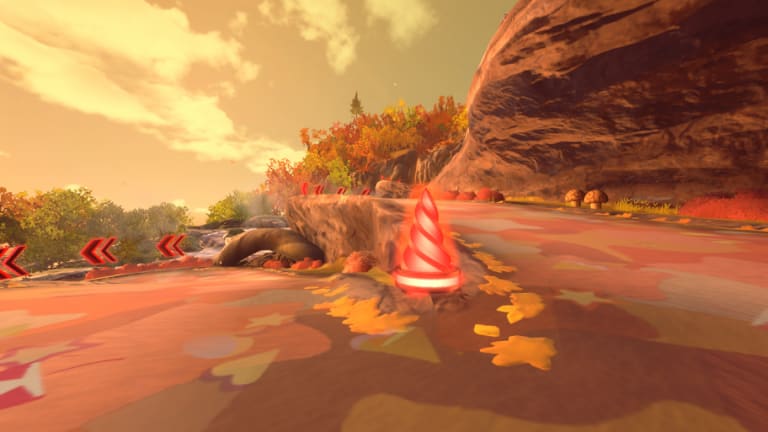
Players might not feel as though there are any particular issues, but making things feel that natural is by far the most difficult thing to achieve.